
Spinal Tumor Excision & Reconstruction Surgery in Mumbai
Non Surgical Spine Treatments
Surgical
Recent Advances
Teleconsultation
CALL FOR APPOINTMENT
8960599999 / 9999985957
drdhanish@dspinesurgeon.com
Expert Surgical Treatment for Spinal Tumors with a Patient First Approach at D Spine Clinic in Mumbai
At D Spine Clinic, a leading destination for spine care in Mumbai, we specialize in advanced spinal tumor surgery and reconstruction. Led by Dr. Dhanish Mehendiratta, one of Mumbai’s top spine surgeons, our clinic is dedicated to delivering comprehensive and compassionate treatment for spinal tumors. We use the latest surgical techniques, including minimally invasive spine surgery, to safely remove tumors, restore spinal stability, and protect nerve function. Our focus is on providing personalized spinal tumor treatment that prioritizes your recovery, comfort, and long-term health. Choose D Spine Clinic in Mumbai for expert care and world-class outcomes in spinal tumor management.
What is a Spinal Tumor?
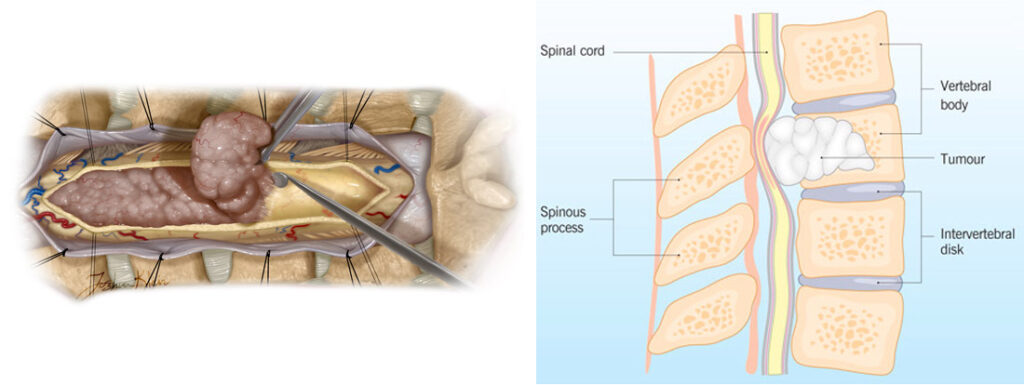
A spinal tumor is an abnormal growth that develops within or around the spinal cord or vertebrae. These tumors can be benign (non-cancerous) or malignant (cancerous) and may originate in the spine or spread from other parts of the body such as the lungs, breast, kidney, or prostate. At D Spine Clinic in Mumbai, we specialize in the diagnosis, excision, and reconstruction of spinal tumors using advanced surgical techniques and minimally invasive procedures.
Connect with D Spine Clinic for Expert Evaluation
If you’re experiencing symptoms of a spinal tumor, early intervention is critical to prevent complications. Contact D Spine Clinic today to schedule a consultation with Dr. Dhanish Mehendiratta, one of Mumbai’s top spine surgeons. Let us help you regain your health and live pain-free.
D Spine Clinic – Your Partner in Spinal Tumor Excision and Reconstruction Surgery in Mumbai.
FAQs
What are the Symptoms of a Spinal Tumor?
Spinal Tumors, whether malignant or benign, can cause different symptoms, including:
- Pain in the back or neck that comes on suddenly, gets worse especially at night can be a hallmark of a spinal tumor.
- Muscle weakness or loss of sensation, especially in the legs and arms.
- Difficulty in walking.
- Abnormal curvature of the spine not caused by poor posture.
- Paralysis.
- Loss of bladder or bowel control.
A patient may not have all of these symptoms or may have a combination of them.
What are the causes of Spinal Tumors?
Many Spinal Tumors originally develop in another part of the body and then metastasize to the spine—these are called Secondary Tumors. Researchers are uncertain what exactly may cause Primary Tumors—those that originate in the spine.
How is Spinal Tumor Diagnosed?
A meticulous medical analysis with importance to back pain and its causes is the primary step to diagnosing a Spinal Tumor. One has to undergo radiological tests for the accurate diagnosis & treatment of spinal tumors.
- X-ray: X-rays of the spine are taken to search for a spinal tumor or other possible causes of pain like infections, fractures, etc.
- Computed tomography scan (CT scan): A CT scan can determine the shape and size of the spinal canal, its contents, and its structures.
- Magnetic resonance imaging (MRI): An MRI helps in viewing the spinal cord, nerve roots, and nearby areas, as well as tumors.
- Bone Scan: Effective as an auxiliary for the association of bone tumors & infections.
What is the Treatment options for a Spinal Tumor?
Treatment depends on many factors, including whether the tumor is benign or malignant, tumor size and location, and symptoms.
- Monitoring (Watch and Wait). Small, benign tumors that aren’t growing or impinging on other structures may only require to be watched for changes through the use of MRI or CT scan studies.
- Radiation therapy
- Stereotactic radiosurgery, which delivers a high dose of radiation specifically targeted to the tumor
- Chemotherapy
- Surgery
What are the Goals of Surgery in Spinal Tumors?
The goals of surgery to treat spinal tumors include:
- Remove the spinal tumor, or as much of it as possible.
- Stabilize the spine.
- Reduce pain.
- Improve function and quality of life.
What are the possible Surgical Procedures for Spinal Tumors?
Decompression: Remove the entire tumor or part of it. These types of procedures decompress or relieve pressure to the spinal cord and nerve roots, thereby helping to reduce pain and other symptoms.
Kyphoplasty or Vertebroplasty: Both are minimally invasive surgical procedures that stabilize a fractured vertebra and help relieve pain.
Kyphoplasty uses orthopaedic balloons that are inserted into the fracture, inflated to create a hole or cavity, and removed before the bone cement is injected.
Vertebroplasty is a newer technique. In combination with radiofrequency ablation it removes the tumor tissue and create a cavity for the bone cement. Radiofrequency ablation uses radio wave energy to break the tumor’s cellular molecular bonds to help remove tissue and create the cavity.
Spinal Stabilization: A spinal tumor can cause your spine to become unstable. Spinal instability increases the risk for serious neurologic injury, such as bowel or bladder dysfunction or paralysis.
Stabilization usually involves spinal instrumentation and bone graft. Instrumentation may include implantation of plates, interbody devices, and screws to immediately stabilize the spine.
Minimally Invasive Procedure For Spinal Tumor
Spinal decompression and Stabilization may be performed as a Minimally Invasive Procedure (Small incision, Early recovery) or by using a more traditional open approach (Longer incision, Longer recovery time).