
Navigation-Assisted Spine Surgery in Mumbai
Non Surgical Spine Treatments
Surgical
Recent Advances
Teleconsultation
CALL FOR APPOINTMENT
8960599999 / 9999985957
drdhanish@dspinesurgeon.com
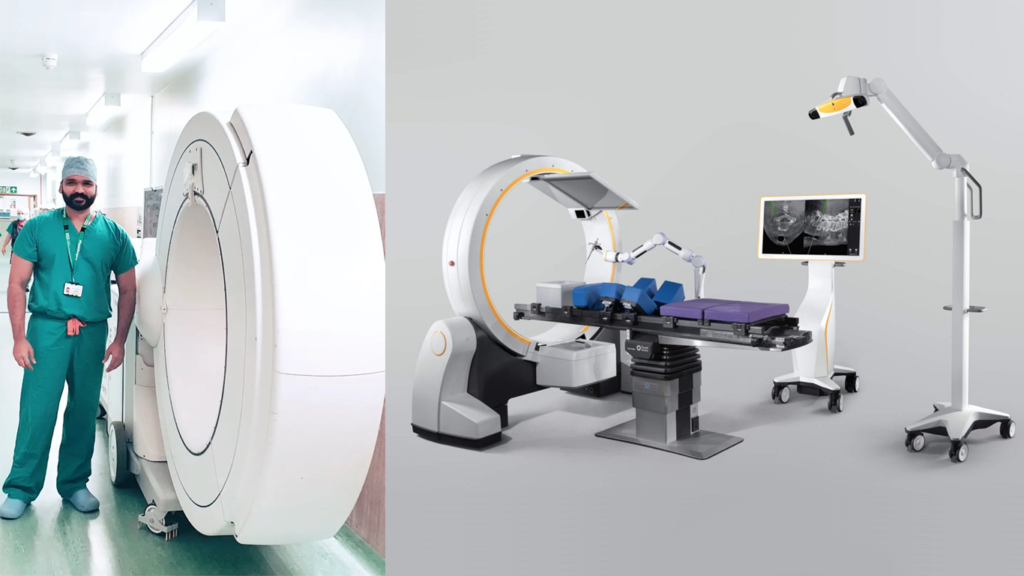
D Spine Clinic uses computer-assisted navigation during selected spine operations where real-time guidance can assist with surgical orientation and implant positioning.
Navigation does not replace the surgeon or determine whether surgery is needed. It is a surgical guidance tool that may be used by Dr Dhanish Mehendiratta when it is relevant to the procedure being performed.
How Navigation Is Used During Spine Surgery
Spinal navigation works in a similar principle to GPS. Imaging of the patient’s spine is linked to a computer navigation system so that the surgeon can see the position and direction of surgical instruments in relation to the spinal anatomy.
Its most established use is during placement of spinal instrumentation such as pedicle screws. Navigation can also be helpful where normal anatomical landmarks are altered or difficult to see.
When May Navigation Be Useful?
Navigation-assisted spine surgery is ideal for cases where millimeter-level accuracy is essential. It is commonly recommended in: complex procedures where additional three-dimensional guidance may assist surgical planning and instrumentation.
These can include:
- Spinal deformity surgery such as scoliosis or kyphosis correction
- Revision surgery where previous surgery has altered the anatomy
- Selected minimally invasive fusion procedures
- Spinal fractures requiring instrumentation
- Selected tumour or infection surgery
- Other procedures requiring precise placement of spinal implants
Navigation is not required for every spine operation. Its use depends on the procedure, anatomy and surgical plan.
Benefits of Navigation-Assisted Spine Surgery at D Spine Clinic
Benefits of Navigation-Assisted Spine Surgery at D Spine Clinic relate mainly to the additional anatomical information available to the surgeon during an operation.
Navigation can:
- Provide three-dimensional guidance during instrumentation
- Assist with accurate pedicle screw placement
- Help the surgeon work with altered or complex anatomy
- Support implant positioning through smaller surgical corridors in selected minimally invasive procedures
- Allow intraoperative verification depending on the navigation and imaging system being used
Navigation improves guidance. It does not by itself guarantee a complication-free operation, faster recovery or a better clinical outcome.
Why Choose D Spine Clinic for Navigation-Assisted Spine Surgery?
- Specialist Spine Expertise: Dr Dhanish Mehendiratta has dedicated training in complex spine, deformity and minimally invasive surgery.
- Technology Used Selectively: Navigation is used when it adds value to the planned operation rather than routinely for every patient.
- Multiple Surgical Approaches: Navigation, robotics, microscopy and minimally invasive techniques have different roles and are considered according to the procedure.
- Second Opinions: Patients already advised spinal instrumentation or complex surgery can consult for review of their scans and surgical plan.
Consult Dr Dhanish Mehendiratta for Navigation-Assisted Spine Surgery
Dr Dhanish Vinod Mehendiratta is an Orthopaedic Spine Surgeon with fellowship training at Hinduja Hospital, the Indian Spinal Injuries Centre and Nottingham University Hospitals.
His specialist training includes spinal deformity, robotics, trauma and complex cervical and lumbar spine surgery.
Patients can consult Dr Dhanish to understand whether navigation is relevant to their proposed operation and what role it would play during surgery.
Book a Spine Surgery Consultation
Consult Dr Dhanish Mehendiratta for assessment, review of scans, surgical planning or a second opinion before spine surgery.
Frequently Asked Questions
Is spinal navigation safe?
Navigation is an established surgical guidance technology. It can provide the surgeon with additional information about instrument and implant position, but overall surgical safety still depends on the operation, anatomy, surgeon’s technique and patient’s health.
Does spinal navigation reduce recovery time?
Not necessarily. Recovery is determined mainly by the operation performed and the patient’s condition. Navigation assists the surgical procedure but does not independently make recovery faster.
Is spinal navigation the same as robotic spine surgery?
No. Navigation shows the surgeon where instruments are positioned in relation to the spine. Robotic systems may use similar imaging and navigation information but can also assist with planning and guiding particular instrument trajectories.
Will I be exposed to more radiation during navigation surgery?
Radiation exposure varies according to the imaging system and surgical workflow. Some navigation techniques use intraoperative CT or 3D imaging, while others can reduce repeated fluoroscopy during parts of the operation. The exposure therefore cannot be assumed to be higher or lower in every case.
Which Spine Conditions Benefit from Navigation-Assisted Surgery?
Navigation is particularly useful when an operation requires accurate spinal instrumentation or involves complex anatomy. This may include selected deformity corrections, spinal fusion, revision procedures, fractures and some tumour or infection surgeries.
Do all spinal fusion surgeries require navigation?
No. Spinal fusion can be performed using different techniques. Whether navigation adds value depends on the spinal level, anatomy, complexity of the operation and the surgeon’s planned approach.
Can I get a second opinion about a navigation-assisted operation?
Yes. If spinal fusion, deformity correction or another instrumented procedure has already been recommended, a second opinion can review the diagnosis, scans, proposed operation and whether navigation or another surgical technology is relevant.
Medical Disclaimer
The information on this page is intended for general patient education and does not replace a medical consultation, diagnosis or individual treatment advice. Suitability for artificial disc replacement depends on a patient’s symptoms, clinical examination, imaging and overall spinal condition. Treatment recommendations may vary from person to person.