
Minimally Invasive Spine Surgery in Mumbai
Non Surgical Spine Treatments
Surgical
Recent Advances
Teleconsultation
CALL FOR APPOINTMENT
8960599999 / 9999985957
drdhanish@dspinesurgeon.com
D Spine Clinic offers Minimally Invasive Spine Surgery in Mumbai for spine conditions that can be treated through smaller surgical access routes without compromising the purpose of the operation.
For some patients, this means treating a compressed nerve or stabilising the spine while disturbing less of the surrounding muscle. For others, an open approach may give the surgeon better access and control.
Dr Dhanish Mehendiratta first determines what needs to be corrected. The surgical approach comes after that decision.
What is Minimally Invasive Spine Surgery?
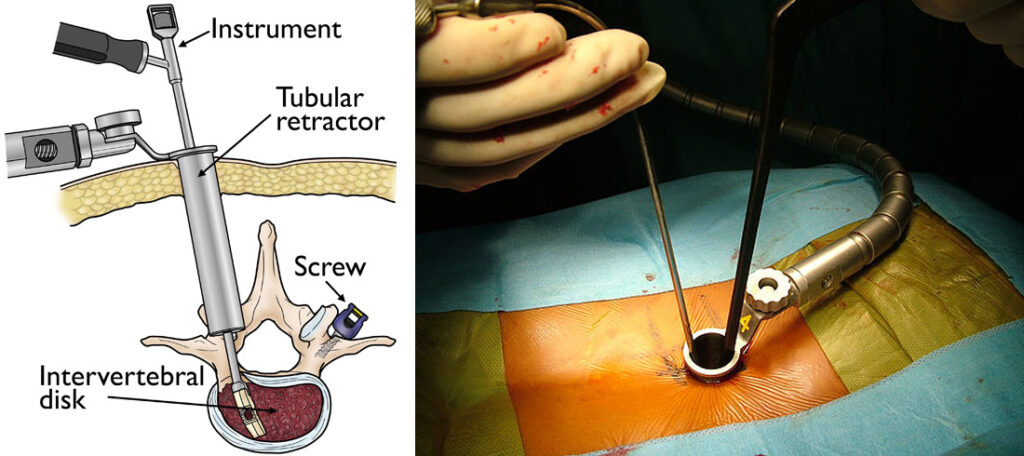
Minimally invasive spine surgery, commonly called MISS, is a way of reaching the spine through smaller openings and working corridors.
Instead of exposing a large area of the spine, the surgeon works directly around the level that needs treatment using specialised instruments. Depending on the operation, a microscope, endoscope, tubular retractor, navigation system or percutaneous screws may be used.
The important distinction is that MISS is not one specific operation. A discectomy, decompression or even certain fusion procedures can be performed using a minimally invasive approach.
The size of the incision matters less than whether the required treatment can be completed properly through it.
Spine Conditions That Can Sometimes Be Treated with MISS
Not every patient with the same diagnosis will have the same operation.
At D Spine Clinic, minimally invasive techniques may be used for:
- Herniated Discs: Disc material pressing on a nerve can sometimes be removed through a microdiscectomy or endoscopic approach.
- Spinal Stenosis: A limited decompression can create more room around compressed nerves without exposing a large section of the spine.
- Spondylolisthesis: Some patients who require stabilisation or fusion can be treated using minimally invasive screw placement and fusion techniques.
- Degenerative Spine Disorders: Certain decompression and fusion procedures can be performed through smaller surgical corridors.
- Spinal Trauma: Selected fractures can be stabilised using percutaneous screws.
- Scoliosis: Minimally invasive techniques can form part of treatment for some adult spinal deformities, although larger or rigid curves may require a more extensive operation.
Whether MISS is suitable is decided from the scans, examination and the exact procedure required, not simply from the diagnosis.
What Are the Real Benefits of Minimally Invasive Spine Surgery?
The main advantage of MISS is reduced disruption to the muscles and soft tissues around the spine.
That can translate into practical benefits in the right operation.
- Smaller Incisions: Many minimally invasive procedures use shorter or fewer incisions than their open equivalent.
- Reduced Blood Loss: Less muscle exposure can reduce blood loss during certain procedures.
- Less Post-Operative Pain: Patients may experience less early muscle-related pain when the surgical exposure is smaller.
- Faster Recovery Time: Earlier mobilisation and a shorter hospital stay are possible after some minimally invasive procedures.
- Lower Risk of Infection: Smaller wounds can reduce some wound-related risks, although infection remains possible after any operation.
- Preservation of Muscle & Tissue: MISS aims to reach the affected part of the spine without unnecessarily stripping surrounding muscles from the bone.
These advantages are procedure-specific.
A minimally invasive fusion is still a fusion. Bone still has to heal. A minimally invasive decompression still has to remove enough pressure from the nerve. The technique should never reduce the effectiveness of the operation simply to keep the incision small.
Am I a Candidate for Minimally Invasive Surgery?
Am I a Candidate for Minimally Invasive Surgery? The answer becomes clearer only after the exact cause of the symptoms has been identified.
Dr Dhanish considers:
- What structure is causing the symptoms
- Whether surgery is actually required
- The number of spinal levels involved
- The amount of decompression or correction needed
- Spinal stability and alignment
- Previous spine surgery
- Whether the required procedure can be performed safely through a smaller access route
Some complex deformities, multi-level reconstructions and revision operations are better treated through an open or combined approach.
The goal is not to make every operation minimally invasive. It is to use the least disruptive approach that still treats the spinal problem properly.
Why Choose D Spine Clinic for Minimally Invasive Spine Surgery?
- Experience Across Different Approaches: Dr Dhanish Mehendiratta works with minimally invasive, microendoscopic and conventional spine techniques.
- The Operation Comes Before the Technique: MISS is chosen only when it suits the diagnosis and the procedure that needs to be performed.
- Technology Used Where It Adds Value: Microscopy, endoscopy, navigation and robotic guidance can be incorporated where they have a useful role.
- Second Opinions Before Surgery: Patients already advised decompression, fusion or another spine operation can consult for review of both the diagnosis and proposed surgical approach.
Consult Dr Dhanish Mehendiratta for Minimally Invasive Spine Surgery
Dr Dhanish Vinod Mehendiratta is an Orthopaedic Spine Surgeon with specialist training in cervical and lumbar spine surgery.
His spine fellowships include training at Hinduja Hospital, the Indian Spinal Injuries Centre and Nottingham University Hospitals. His clinical work includes minimally invasive and microendoscopic spine surgery, along with robotics, spinal deformity and complex spine procedures.
At D Spine Clinic, patients considering minimally invasive spine surgery can consult Dr Dhanish for diagnosis, review of scans, surgical planning and second opinions.
The consultation helps determine whether a minimally invasive approach is suitable for the condition being treated and whether it can achieve the required decompression, stabilisation or fusion safely and effectively.
Book a Minimally Invasive Spine Surgery Consultation
Consult Dr Dhanish Mehendiratta if you have been advised spine surgery, want to understand whether a minimally invasive approach is possible, or would like a second opinion on a proposed procedure.
FAQs
What is Minimally Invasive Spine Surgery (MISS)?
MISS is a way of performing certain spine operations through smaller working corridors with less exposure of the surrounding muscles. It can be used for procedures such as discectomy, decompression and some spinal fusion operations.
How Is Minimally Invasive Spine Surgery Different from Open Surgery?
The main difference is the route used to reach the spine. Open surgery gives the surgeon wider exposure. MISS limits that exposure and focuses the working area around the level being treated.
Neither approach is automatically better. The correct approach depends on what needs to be done.
Can Minimally Invasive Spine Surgery really be performed through an incision of one inch?
Some procedures can be performed through an incision around that size. Others require more than one incision or a larger working corridor.
There is no fixed incision size that defines MISS.
Is minimally invasive spine surgery always safer?
No. MISS can reduce tissue disruption, but every operation has risks. Safety depends on the condition, procedure, anatomy, surgeon’s experience and the patient’s overall health.
What Is Recovery from Minimally Invasive Spine Surgery Like?
Recovery varies by operation.
Someone having a small lumbar decompression or microdiscectomy may return to routine activity relatively quickly. A patient having minimally invasive spinal fusion still requires a longer period for healing and rehabilitation.
Can minimally invasive surgery avoid spinal fusion?
Not if fusion is genuinely required.
MISS can change how a fusion is performed, but it does not remove the need for fusion when instability or another structural problem requires stabilisation.
Do robotics and navigation mean my operation is minimally invasive?
No. Robotics and navigation are guidance technologies. They can be used during minimally invasive surgery, but they can also be used during other types of spine operations.
Can I get a second opinion about whether MISS is suitable for me?
Yes. Bring your MRI, X-rays or CT scans, previous reports and any surgical recommendation you have received. Dr Dhanish can review whether surgery is required and whether the same treatment can reasonably be performed through a minimally invasive approach.
Medical Disclaimer
The information on this page is intended for general patient education and does not replace a medical consultation, diagnosis or individual treatment advice. Suitability for artificial disc replacement depends on a patient’s symptoms, clinical examination, imaging and overall spinal condition. Treatment recommendations may vary from person to person.